


 Shriya KaushikKhaleesi of Data
Sign up to receive latest insights & updates in technology, AI & data analytics, data science, & innovations from Polestar Analytics.
❒ How Agentic AI revolutionizes Revenue Growth Management (RGM) by transforming static analysis into autonomous, real-time insights and action.
❒ How Databricks empowers Agentic RGM through unified data, AI-driven analytics, and intelligent automation.
❒ How Profit Pulse delivers measurable outcomes in trade promotion optimization, price elasticity modelling, and spend efficiency.
❒ How CPG enterprise can implement Agentic RGM for continuous revenue growth and competitive agility.
Global FMCG value-sales growth of 2025 was just 3.5%, and volume growth only +0.9%, It is lower (~4.5%) than 2024, says Nielsen. Yet, these same companies continue to pour some of their largest budgets into trade promotions, even though only about 46% of these programs deliver a positive ROI.
So, what's happening?
Your trade spend flows through ERP systems, like SAP. Promotional data lives in TPM tools, like Salesforce or Anaplan. Customer insights hide in CRM platforms like Salesforce or Zoho. Sales teams manage pricing in spreadsheets. And somewhere between these disconnected systems, billions in revenue leak away invisible until it's too late.
While many CPG companies think to turn AI to solve these problems, there’s disconnect. 71% of the CPG leaders have adopted AI in at least one business function of their organizations, yet none have truly scaled their AI capabilities. They are primarily in their pilot phases.
The issue isn't technology, it's that legacy revenue growth management approaches can't handle autonomous, real-time revenue optimization. It’s because their data + AI foundation is not rock solid!
Let's talk about what's happening in most organizations. The pain point of most revenue leaders - getting clean and unified data. It is because of:

The result?
Your channel managers conduct price optimization or promotional planning once a quarter. But till then, market conditions shift, competitors move ahead and opportunities vanish before you get the wind of it.
You can't optimize what you can't see clearly!
Do you know?
Only 10% of CPG and retail companies have integrated AI agents across their workflows.
It's not about lacking tools; it's about having set of processes that don’t alert you on market shifts. They can't act autonomously on the insights buried in your data. And this lag is going to keep you behind the competition.
Agentic RGM is a shift from reactive to proactive revenue intelligence.
These systems autonomously perceive market signals, reason through complex trade-offs in real-time, and adapt strategies with constant human in loop guidance. Instead of quarterly "what happened?" reports, you get continuous alerts of "here's what to do now and why" intelligence with real-time pricing optimization, autonomous promotional orchestration, and self-learning from patterns.
In short, Agentic RGM turns static analysis into learning systems that act with context and speed.
The Agentic RGM Opportunity
Remember that data fragmentation challenge we talked about? It's not just a data problem- it's an architecture problem. Legacy data warehouses weren't built for autonomous agents. They excel at historical reporting but can't support continuous learning, real-time decision-making, and adaptive intelligence that modern RGM demands.
They lack the ability to-
Databricks becomes your end-to-end enabler for this. It serves as the backbone for data cleaning, governance and lineage, observability to generating actionable insights to automating decisions with humans in the loop.

The end-to-end journey for Agentic RGM looks like -
➦ Step 1: Data Foundation – Databricks Lakehouse with Unity Catalog ingests, cleans and harmonizes fragmented data with Delta live tables (DLT) or Lakeflow from ERP, POS or CRM systems seamlessly. This solves the critical clean data pain point at scale.
➦ Step 2: Analytics – Delta Lake creates bronze, silver, gold layers for real-time analytics. Mosaic AI, MLflow, and Feature Store train and deploy RGM models.
➦ Step 3: Interpretation – Databricks SQL and AI/BI Genie power conversational analytics. Teams can ask "Which promotions are cannibalizing margin?" in plain English and get instant answers!
➦ Step 4: Automation – Agentbricks and Mosaic AI Agent Framework orchestrate autonomous agents with real-time alerts. (Channel managers receive: "Competitor X dropped pricing 8% in Region Y -> We'll lose 12% volume without 48-hour response. -> Here are three strategies.")
This cohesive architecture ensures every data point is contextualized, every decision explainable, and enterprise-grade intelligence.
| Architecture Layer | Purpose | Key Databricks Tools |
|---|---|---|
| Source | Ingest from ERP, POS, CRM, syndicated | Delta live tables (DLT), Lakeflow, Auto Loader |
| Transformation | Clean, harmonize, prepare for intelligence | Delta Live Tables, Structured Streaming, Unity Catalog |
| Repository | Unified, governed, versioned storage | Delta Lake (Bronze/Silver/Gold), Unity Catalog |
| AI/ML | Train, tune, deploy RGM models | Mosaic AI, MLflow, Feature Store, Repository |
| Agentic Layer | Orchestrate autonomous revenue agents | Agentbricks, Mosaic AI Agent Framework |
| Consumption | Expose insights, APIs, dashboards | Databricks SQL, Lakehouse Federation, Model Serving |
| User Layer | Natural language interaction, custom apps | Mosaic AI Chat Interface |
Why This Matters?
With real-time, enterprise grade governance and explainable autonomous decision-making at scale. You move from fragmented data chaos to unified intelligence view for your revenue growth management.
Databricks enables a new era of autonomous revenue decision-making. With Profit Pulse, native to Databricks- we've built an AI-driven RGM solution with agentic architecture that transforms decision-making from reactive to prescriptive. It perceives market shifts in real-time and recommends actions. This is data to outcomes, simplified!
➧ Price Elasticity Agent:ations with Feature Store storage and MLflow versioning.
➧ Promo ROI Agent: Uses causal inference (T-Learner, S-Learner, Double ML) to isolate true lift from cannibalization. Generates autonomous promotion calendars via Delta Live Tables and Mosaic AI.
➧ Forecast Agent: Blends time-series, event data, and market signals for demand prediction with continuous learning.
➧ Spend Optimization Agent: Applies ML-driven budget allocation using genetic algorithms within constraints (budget limits, margin floors etc).
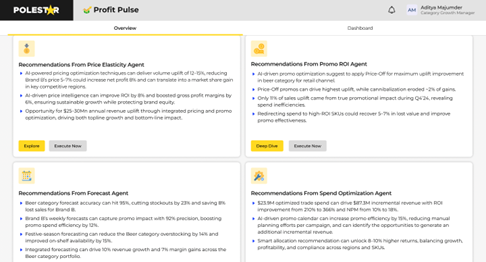
Profit Pulse- It is an AI driven RGM for creating and configuring AI or statistical function agents to process inputs and generate outputs. Agents can be linked to automate workflows by triggering actions based on processed data.
Dive into the world of Dynamic Pricing and its significance in catering to the hyper-personalized consumer market. Embrace the age of hyper-personalization by discovering how consumer markets can effectively leverage the trend.
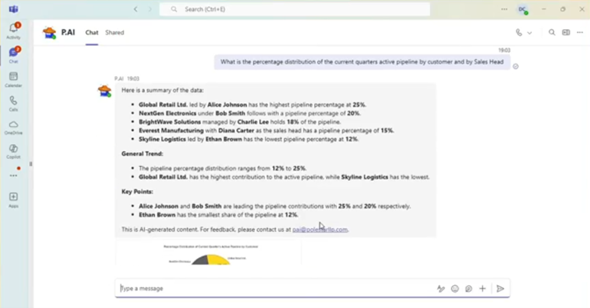
Explore the top use cases of Agentic AI in RGMChannel managers can ask questions in natural language through Mosaic AI chatbots: "Which skus are losing share in the Midwest?" The system sends proactive alerts when margins are at risk or competitors move- transforming quarterly optimization into continuous, responsive decision-making.
Descriptive (past performance visibility), Predictive (elasticity insights), Prescriptive (next-best recommendations), Decision Loop Simulator (test scenarios). Vector search and RAG techniques integrate competitor pricing and trends. Unity Catalog ensures governance and auditability.
Here's the pragmatic path forward with Polestar Analytics as your trusted partner:
Databricks provides unified data + AI capabilities to analyze promotion performance. It helps to calculate real-time elasticity and run “what-if” scenarios at scale. The agentic layerof Profit Pulse automates optimal promotion depth, timing, and channel mix. All these features optimize promotion and pricing efforts.
For agentic RGM, scenario planning would include - rapid simulation of pricing strategies, promotional calendars, and assortment changes across thousands of SKU-channel combinations. These are supported by Decision Loop Simulators that test AI-generated scenarios before execution. Databricks features like Delta Lake, Mosaic AI, MLflow and Unity Catalog.
Profit Pulse natively built on Databricks has Real-time alerts. When margin thresholds are at risk, it notifies the user instantly. The continuous monitoring of competitor moves, cost changes, and demand shifts with margin-protective action recommendations makes the revenue growth management proactive than reactive. This approach protects margins in a volatile market, especially for CPG/Retail industries.
Fragmented systems mask revenue leakage. Quarterly reviews and reactive decision-making are competitive liabilities.
The shift to agentic RGM gives revenue leaders continuous visibility, real-time intelligence, and proactive recommendations for better, faster decisions.
But here's what organizations miss: This isn't just about tools- it's about set of practices.
Databricks provides the technical foundation. Agentic AI provides intelligence. Polestar Analytics provides the depth of experience to deliver simplistically. Real transformation happens when you rethink revenue management- from data governance to cross-functional collaboration to decision rights.
That journey requires deep RGM expertise, data architecture knowledge, and change management- not just technology.
And having us as your trusted partner through this journey makes all the difference. At Polestar Analytics, we've helped CPG and retail organizations navigate this transformation. Ready to see what's hiding in your data? Let's talk!
About Author

Khaleesi of Data
Commanding chaos, one dataset at a time!
Related Blog
 Ali kidwai
